Want to see your own seven scores first? Start with our free 14- or 28-question 7 deadly sins test to measure Pride, Greed, Lust, Envy, Gluttony, Wrath, and Sloth in two minutes, then use this guide to unpack every score.
Where the Seven Deadly Sins Meaning Comes From
To understand the seven deadly sins meaning accurately, you have to travel back before medieval cathedrals to fourth-century Egypt. Around 375 AD, a Christian monk named Evagrius Ponticus observed what happened when people left noisy cities to live alone in the desert. Without external distractions, human restlessness did not vanish; instead, it distilled into eight recurring mental loops he called logismoi (diagnostic thoughts). Evagrius was writing practical psychology: what makes a person abandon discipline at noon, hoard supplies, resent a peer, or rehearse old anger?
Two centuries later, in 590 AD, Pope Gregory I revised Evagrius's eight thoughts into seven capital vices, folding Vainglory into Pride, blending Sadness into Sloth (acedia), and adding Envy. In the thirteenth century, Thomas Aquinas analyzed the seven deadly sins meaning systematically in the Summa Theologiae, showing that each vice is a disordered pursuit of a genuine good - safety, honor, pleasure, or rest - chased past healthy proportion. Soon after, Dante Alighieri organized Mount Purgatory around these exact seven tendencies.
7 Deadly Sins Test Bible Origins: Proverbs 6 and Galatians 5
Visitors searching for a 7 deadly sins test bible reference are often surprised to learn that the phrase "seven deadly sins" never appears verbatim in Old or New Testament scripture. Instead, early Christian teachers synthesized the seven-trait framework from key biblical passages that diagnose the same underlying motives:
| Classical Test Trait | Closest Scripture Parallels | Core Biblical & Moral Focus |
|---|---|---|
| Pride (Superbia) | Proverbs 6:17 ("haughty eyes"); Proverbs 16:18 | Elevating self-status above truth and neighbor |
| Greed (Avaritia) | Luke 12:15; 1 Timothy 6:9-10 | Treating possessions and wealth as ultimate security |
| Lust (Luxuria) | Matthew 5:28; Galatians 5:19 | Unchecked craving that overrides fidelity and respect |
| Envy (Invidia) | Proverbs 14:30; Galatians 5:21 | Resentment when someone else receives blessing or praise |
| Gluttony (Gula) | Proverbs 23:20-21; Philippians 3:19 | Letting appetite and overindulgence rule daily discipline |
| Wrath (Ira) | James 1:19-20; Galatians 5:20 | Sudden heat, hatred, and vengeful score-settling |
| Sloth (Acedia) | Proverbs 6:6-11; Hebrews 6:11-12 | Neglecting calling, diligence, and steady care |
When someone looks up a 7 deadly sins test bible edition today, they are testing those exact timeless motives - prideful eyes, envy at a neighbor's good, impatient anger, or disengaged sloth - translated into everyday modern choices.
All Seven Traits Explained: Classical Seven Deadly Sins Meaning
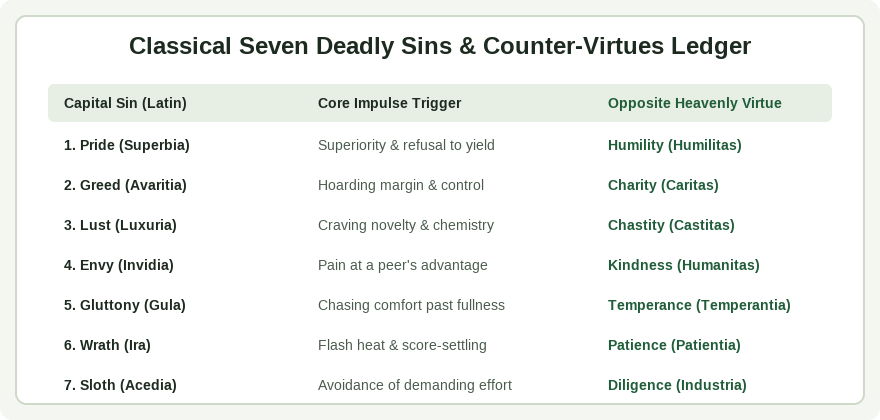
Every percentage bar on our 7 deadly sins test maps back to a specific seven deadly sins meaning and its 7 deadly sins test opposite virtue:
1. Pride (Superbia) - Opposite: Humility
Historically called the queen of vices, Pride is an inflated attachment to personal superiority, status, or infallibility. Healthy self-respect enjoys doing excellent work; within the seven deadly sins meaning, Pride needs to stand above others for the work to count, making sincere apologies and open feedback feel threatening.
2. Greed (Avaritia) - Opposite: Charity
Greed is excessive attachment to money, possessions, or strategic leverage beyond genuine need. Where prudence saves wisely, Greed treats accumulation as an endless scoreboard - hoarding credit, guarding shortcuts, and weighing relationships by financial or career return.
3. Lust (Luxuria) - Opposite: Chastity
Beyond narrow physical desire, the broader seven deadly sins meaning of luxuria describes an unbridled hunger for intense chemistry, novelty, and magnetic attention whenever steady commitment starts feeling ordinary.
4. Envy (Invidia) - Opposite: Kindness
Aquinas defined Envy concisely as "sorrow for another's good." Unlike Greed, which wants more resources, Envy stings specifically because a peer - a colleague, classmate, or neighbor - won the recognition or ease you wanted for yourself.
5. Gluttony (Gula) - Opposite: Temperance
Gluttony is consuming past fullness in search of immediate comfort or dopamine relief. Medieval writers noted five forms: eating too soon, too expensively, too much, too eagerly, or too fussily - a pattern that today includes late-night delivery binges and marathon comfort scrolling.
6. Wrath (Ira) - Opposite: Patience
Wrath is uncontrolled heat and the urge to punish when boundaries or fairness feel violated. Within the seven deadly sins meaning, Wrath differs from healthy boundary-setting by refusing proportion and replaying grievances long after an incident ends.
7. Sloth (Acedia) - Opposite: Diligence
Rather than simple sleepiness, classical acedia - the "noonday demon" - is mental and spiritual avoidance: staying busy with effortless distractions while postponing demanding work, craft, or responsibility.
Dante's Three Categories of Disordered Love
In Purgatorio, Dante summarized the seven deadly sins meaning through three ways human love loses balance:
- Distorted Love (Pride, Envy, Wrath): Resenting or diminishing a neighbor so the self feels taller or avenged.
- Deficient Love (Sloth): Moving too slowly toward worthwhile effort and commitments.
- Excessive Love (Greed, Gluttony, Lust): Chasing real earthly goods - wealth, food, and attraction - without measure.
Ready to see how these seven tendencies and their 7 deadly sins test opposite virtues show up in your own life? Take the full 7 deadly sins test on the home page, measure your positive anchors on the 7 Heavenly Virtues Test, or run a 90-second friend overlay on the Seven Deadly Sins Percentage Quiz.