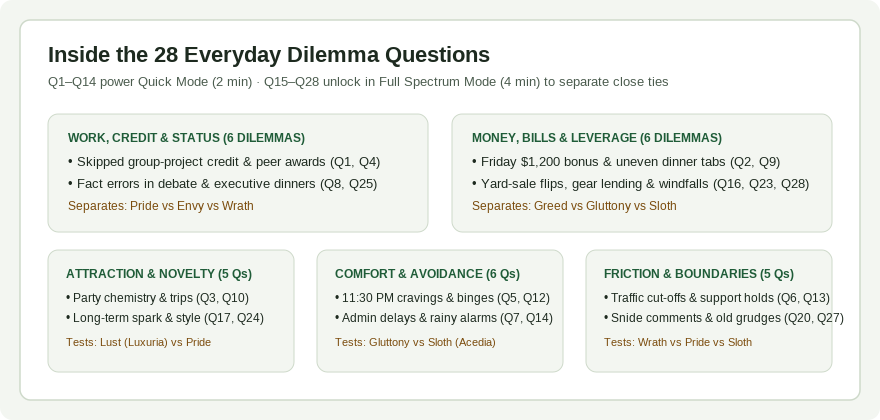
How the 28 7 Deadly Sins Test Questions Are Structured
The 7 deadly sins test questions on 7deadlysinstest.vip consist of 28 original everyday dilemmas split into two layers: Questions 1 through 14 power the two-minute Quick Mode, while Questions 15 through 28 unlock in Full Spectrum Mode to separate close runner-up traits across wider relationship, money, and ego trade-offs.
Instead of asking religious trivia or obvious self-ratings like "Are you a greedy person?", every item drops you into a recognizable friction point with four concrete reactions. Reading through how these scenario prompts work helps you understand your score report - or run live discussion rounds with friends, partners, or a group chat.
Tip before reading: If you want an unbiased gut score first, take the interactive 7 deadly sins test before studying the option weights below so you do not overthink your clicks.
Five Everyday Arenas Covered by the Question Bank
To prevent one area of life from skewing your chart, the 28 7 deadly sins test questions rotate across five everyday arenas:
- Work, Credit & Public Status (Q1, Q4, Q8, Q15, Q22, Q25): How you react when a colleague skips your contribution, a newer peer wins an award, a fact slips mid-debate, or senior leadership hosts a closed dinner.
- Money, Shared Bills & Leverage (Q2, Q9, Q11, Q16, Q23, Q28): What happens first with an unexpected bonus, an uneven six-person restaurant tab, a friend's family-assisted house purchase, a yard-sale bargain, or total financial freedom.
- Attraction, Spark & Personal Magnetism (Q3, Q10, Q17, Q24): What pulls your eye at a crowded party, defines an unforgettable trip, triggers restlessness in long commitments, or guides how you dress.
- Late-Night Comfort & Task Avoidance (Q5, Q7, Q12, Q14, Q19, Q21, Q26): How you handle non-hungry 11:30 PM cravings, ten-day admin deadlines, Sunday-night streaming drops, rainy workout alarms, hotel buffets, and 400 unread messages.
- Boundaries, Traffic & Unresolved Slights (Q6, Q13, Q18, Q20, Q27): Your reflex when cut off in traffic, blamed after a 25-minute support hold, checking an old rival's feed, reading a snide comment, or remembering an unapologized slight.
Sample 7 Deadly Sins Test Questions & Hidden Weight Logic
Here is an inside look at six representative dilemmas from both modes and how each four-way choice separates overlapping impulses:
| Question # & Mode | Everyday Scenario Prompt | How the Four Choices Separate Traits |
|---|---|---|
| Q1 (Quick & Full) | A colleague presents a group project and skips over the part you designed. What happens in your head first? | Smooth Q&A mention (+3 Pride); blunt call-out message (+2 Wrath, +1 Pride); checking who in leadership noticed (+2 Envy, +1 Pride); shrugging off extra tasks (+2 Sloth). |
| Q2 (Quick & Full) | You receive an unexpected $1,200 bonus on Friday afternoon. What is your honest first move? | Move straight to investments (+3 Greed); feast with extra courses (+3 Gluttony); striking outfit & electric night out (+2 Lust, +1 Pride); outsource chores to do nothing (+2 Sloth, +1 Gluttony). |
| Q5 (Quick & Full) | It is 11:30 PM after a draining day. You are not physically hungry, yet the kitchen or delivery app calls. | Order rich comfort food anyway (+3 Gluttony); scroll captivating photos & chats in bed (+2 Lust, +1 Sloth); skip over delivery fees on principle (+2 Greed, +1 Wrath); pass out with lights on (+3 Sloth). |
| Q9 (Quick & Full) | Six friends split a restaurant bill, and you ordered a plain entree while others had cocktails and desserts. | Calculate exact shares down to tax and tip (+3 Greed); order decadent dessert next time (+2 Gluttony, +1 Envy); call out unfair equal splitting (+2 Wrath, +1 Greed); pay even split to avoid math (+2 Sloth). |
| Q17 (Full Spectrum) | In a long-term relationship or creative project, when does restlessness creep in? | When spark and electricity fade (+3 Lust); when peers look happier (+3 Envy); when minor annoyances trigger snaps (+3 Wrath); when steady effort feels unglamorous (+3 Sloth). |
| Q28 (Full Spectrum) | If every financial bill were permanently paid starting tomorrow, what is the biggest trap you might fall into? | Drifting through unscheduled days (+3 Sloth); endless feasting and comfort (+3 Gluttony); chasing intoxicating thrills (+3 Lust); still multiplying the fortune (+3 Greed). |
Notice why these 7 deadly sins test questions rarely feel repetitive: a single prompt never tests just "good versus bad." Instead, it pits four distinct human priorities against one another under the same roof. To see how those raw points convert into 0% to 100% bars, read our breakdown of 7 deadly sins test accuracy.
Why Lust and Sloth Prompts Stay Everyday and Safe-for-Work
Two categories in classic 7 deadly sins test questions often worry group-chat players before they click Start:
- Zero Explicit Content on Lust Items: Classical luxuria describes an intense appetite for chemistry, novelty, allure, and emotional charge. Prompts focus on eye contact across a party, unforgettable travel atmosphere, style choices, and keeping long-term spark alive - completely comfortable to answer alongside friends or coworkers.
- Sloth Measures Avoidance, Not Just Sleep: Following the desert monastic concept of acedia, Sloth prompts test mental postponement - leaving an easy 20-minute form open for nine days (Q7) or closing an inbox of 400 unread messages (Q21) - rather than physical exhaustion alone.
How to Use These Scenarios for Group Chats, Couples, or Icebreakers
Many visitors look up 7 deadly sins test questions to host an interactive conversation in Discord, on a road trip, or over dinner:
- Guess-Your-Partner Round: Read three scenarios out loud (such as Q2's Friday bonus, Q6's lane cut-off, and Q10's ideal vacation) and have each person write down which option they think the other will pick before revealing answers.
- 90-Second Live Radar Overlay: If your group wants instant side-by-side charts without reading all 28 items aloud, open the 10-question Seven Deadly Sins Percentage Quiz and pass the comparison link around the table.
- Compare Dominant Pairings: Once everyone finishes the full 7 deadly sins test on their own phone, look up each person's two-trait combination in our 7 deadly sins test results guide.