How Accurate Is the 7 Deadly Sins Test for Everyday Self-Reflection?
7 deadly sins test accuracy comes from behavioral consistency rather than clinical diagnosis: across 14 or 28 concrete life scenarios, the calculator tracks which impulse you repeatedly prioritize when status, money, comfort, fairness, or excitement collide. Honest answers produce a clear mirror of your current habits, though scores are never a medical or psychiatric evaluation.
Unlike one-word novelty quizzes that discard six traits and hand out a random badge, 7deadlysinstest.vip publishes every weight and ceiling openly. Understanding the math behind 7 deadly sins test accuracy shows both what your heptagon chart captures reliably and where any brief self-report tool reaches its natural limits.
Exact Point Ceilings in Quick Mode vs Full Spectrum Mode
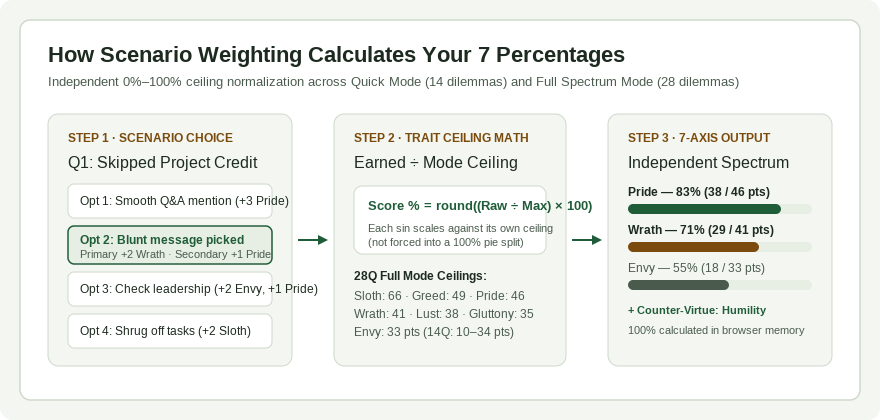
Each prompt offers four realistic reactions. Selecting an option awards up to 3 primary points to its main tendency and, where real human motives overlap, 1 secondary point to a supporting tendency. At the end of your run, the browser divides your raw points on each trait by the maximum points reachable for that trait in your chosen mode:
| Classical Trait | Quick Mode Ceiling (Q1-Q14) | Full Spectrum Ceiling (Q1-Q28) | Single 3-Point Swing in 28Q Mode |
|---|---|---|---|
| Pride (Superbia) | 24 points | 46 points | ~6.5 percentage points |
| Greed (Avaritia) | 25 points | 49 points | ~6.1 percentage points |
| Lust (Luxuria) | 15 points | 38 points | ~7.9 percentage points |
| Envy (Invidia) | 10 points | 33 points | ~9.1 percentage points |
| Gluttony (Gula) | 22 points | 35 points | ~8.6 percentage points |
| Wrath (Ira) | 17 points | 41 points | ~7.3 percentage points |
| Sloth (Acedia) | 34 points | 66 points | ~4.5 percentage points |
This table explains why Full Spectrum Mode improves 7 deadly sins test accuracy whenever two middle bars sit close together. In the 14-question Quick Mode, Envy has a compact 10-point ceiling, so changing a single 3-point answer shifts Envy by 30 percentage points. Expanding to all 28 7 deadly sins test questions raises Envy's ceiling to 33 points and Lust's ceiling to 38 points, smoothing out single-question noise so persistent patterns stand out.
Why Scenario Trade-Offs Beat Agree-Disagree Sliders
Traditional personality pages often present blunt self-labels such as "I frequently envy successful peers" on a five- or seven-point agree slider. Psychometric researchers call the main flaw in those sliders social desirability bias: most readers instinctively soften answers that sound flattering or harsh in the abstract, and different people treat "Somewhat Agree" very differently.
Forced-choice dilemmas improve 7 deadly sins test accuracy in three practical ways:
- Concrete Behavioral Anchors: Instead of judging whether you are "greedy" in general, you react to splitting an uneven dinner bill (Question 9) or receiving an unexpected Friday bonus (Question 2).
- Competing Everyday Motives: Every option represents a plausible human reflex - speaking up for credit, confronting unfairness, checking peer status, or protecting your free weekend - so no single button reads like a moral halo.
- Secondary Overlap Weights: Real frustration often mixes Wrath with Pride, and late-night comfort often blends Gluttony with Sloth. Dual weights prevent artificial all-or-nothing buckets.
Why Your Percentages Can Shift When You Retake the Test
Visitors sometimes ask whether a 10% to 15% shift two weeks later means 7 deadly sins test accuracy is unstable. In practice, moral temperament tools measure state-sensitive habits rather than fixed traits like height:
- Recent Stress & Fatigue: Taking the assessment at 11:30 PM after an exhausting workweek naturally elevates Gluttony and Sloth choices compared with a rested Tuesday morning.
- Fresh Friction Events: An unresolved argument at work or an unfair bill that same day primes Wrath and Pride responses on boundary scenarios.
- Close Runner-Up Ties: If your top two traits sit within 5 percentage points in Quick Mode, switching to the 28-question Full Spectrum mode on the 7 deadly sins test home page gives twice as much behavioral evidence to separate them.
Four Honest Limits: What This Assessment Cannot Measure
Clear 7 deadly sins test accuracy requires stating plainly what this tool is not built to do:
- Not a Clinical or Medical Instrument: The seven capital vices come from fourth-century monastic observation (Evagrius Ponticus) and sixth-century moral philosophy (Pope Gregory I), not modern DSM clinical diagnostics. High Sloth (acedia) is not a depression screening, and high Wrath is not an anger-disorder diagnosis.
- Self-Report Blind Spots: The calculator only sees the option you click. If you answer for the composed person you wish to be rather than what you actually did last week, Pride can mask other impulses.
- Cultural & Situational Context: Calculating exact restaurant shares may reflect a tight student budget rather than lifelong Greed; read your 7 deadly sins test results alongside your real life stage.
- No Moral Verdict: Scoring 78% on Pride or Lust describes where your attention and energy pull hardest - every trait carries a healthy core drive alongside its excess.
Ready to test your own baseline with full 28-question resolution? Launch the free 7 deadly sins test in your browser, or pair your profile with the 7 Heavenly Virtues Test to see which counter-virtues already anchor your habits.