What Your 7 Deadly Sins Test Results Include
Your 7 deadly sins test results on 7deadlysinstest.vip deliver four connected insights at zero cost: your highest-scoring dominant tendency, a full 0% to 100% bar ranking across all seven classical traits, a primary-times-secondary compound behavioral portrait, and a concrete counter-virtue habit to restore balance.
Because each trait scales independently against its own point ceiling rather than squeezing into a single 100% pie chart, your seven-bar profile captures both direction (which impulse leads) and intensity (whether your scores cluster calmly in the 30s or spike above 75% on three traits at once). Haven't generated your chart yet? Take the free 7 deadly sins test first, then use this reference to unpack every bar.
Score Intensity Tiers: Reading 0% to 100% Bars
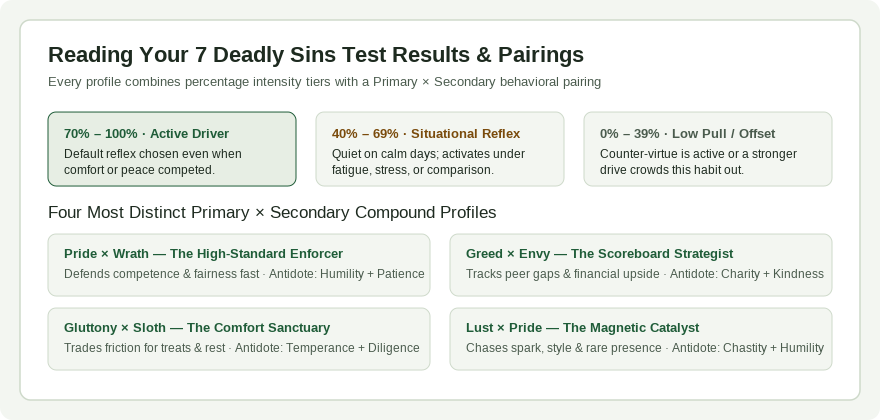
Before focusing on the single trait at the top of your card, check where each bar lands across the three intensity bands used in 7 deadly sins test results:
- 70% to 100% (Active Driver): You chose this motive repeatedly even when social ease, savings, or rest pulled the other way. Friends and coworkers likely recognize the healthy side of this drive - high standards, ambition, warmth, or fairness - as well as its blind spots under pressure.
- 40% to 69% (Situational Reflex): This tendency stays measured on ordinary days and steps forward under specific triggers: exhaustion for Gluttony and Sloth, peer comparison for Pride and Envy, or broken rules for Wrath.
- 0% to 39% (Low Pull or Counter-Balanced): Either you actively practice the opposing virtue here, or a louder priority crowds it out. Low scores across all seven bars are a genuine outcome too, signaling an even-keeled temperament across the 7 deadly sins test questions.
All 7 Dominant Profiles Explained
Here is what each ruling trait means when it lands at #1 in your 7 deadly sins test results, including its everyday upside, unchecked shadow, and classical counter-virtue practice:
1. Dominant Pride (Superbia) — Counter-Virtue: Humility
- Everyday Upside: Sharp personal standards, strong self-reliance, and willingness to take ownership when quality matters.
- Unchecked Shadow: Turning constructive feedback into a personal slight, steering group conversations back to your own competence, and treating asking for help like losing ground.
- Weekly Reset Habit: Credit one specific teammate or friend out loud in your next win, and let one minor inaccuracy pass uncorrected in casual conversation.
2. Dominant Greed (Avaritia) — Counter-Virtue: Charity
- Everyday Upside: Financial preparedness, eye for value, and careful stewardship of margin and time.
- Unchecked Shadow: Treating savings, leverage, and favors as an endless scoreboard where no cushion ever feels safe enough, weighing relationships by return on investment.
- Weekly Reset Habit: Give away something genuinely useful - twenty minutes of expertise, credit on a task, or picking up coffee - without tracking whether it comes back.
3. Dominant Lust (Luxuria) — Counter-Virtue: Chastity
- Everyday Upside: High vitality, creative spark, aesthetic appreciation, and an ability to make ordinary moments feel alive.
- Unchecked Shadow: Losing interest the moment steady commitments turn predictable, chasing emotional electricity, magnetic attention, or constant novelty over lasting depth.
- Weekly Reset Habit: Practice chastity of focus by giving uninterrupted, phone-down attention to one person or long-term craft well past the initial excitement phase.
4. Dominant Envy (Invidia) — Counter-Virtue: Kindness
- Everyday Upside: Acute awareness of what you secretly care about achieving; envy often points straight at unfulfilled ambition.
- Unchecked Shadow: Measuring self-worth against nearby peers so someone else's promotion, home, or praise quietly drains joy from your own progress.
- Weekly Reset Habit: Celebrate a peer's good news out loud within ten seconds of hearing it, before internal comparison starts auditing their luck.
5. Dominant Gluttony (Gula) — Counter-Virtue: Temperance
- Everyday Upside: Warmth, sensory enjoyment, hospitality, and knowing how to savor good food and restorative comfort.
- Unchecked Shadow: Reaching automatically for one more course, late-night delivery order, episode, or dopamine scroll past fullness whenever stress spikes.
- Weekly Reset Habit: Practice the eighty-percent rule - pause one bite, one episode, or one impulse cart item earlier than habit asks.
6. Dominant Wrath (Ira) — Counter-Virtue: Patience
- Everyday Upside: Courage to defend boundaries, low tolerance for hypocrisy, and instinctive protection of fairness.
- Unchecked Shadow: Disproportionate heat that scorches allies and keeps you replaying exact sentences from old arguments long after everyone else moved on.
- Weekly Reset Habit: Insert a deliberate ninety-second pause - or a short walk away from the screen - before sending any reply written in frustration.
7. Dominant Sloth (Acedia) — Counter-Virtue: Diligence
- Everyday Upside: Low interpersonal drama, calm nervous system, and refusal to trample others in pointless status races.
- Unchecked Shadow: Chronic avoidance of demanding commitments - staying busy with effortless distractions while important tasks quietly shrink your future options.
- Weekly Reset Habit: Use a five-minute start rule each morning: touch the single hardest obligation on your list before opening any feed or chat app.
Common Primary × Secondary Compound Pairings
Two people with the same #1 trait often act very differently depending on their #2 bar. Watch for these four frequent pairings in 7 deadly sins test results:
| Primary × Secondary | Behavioral Archetype | Signature Everyday Pattern | Dual Virtue Balance |
|---|---|---|---|
| Pride × Wrath | The High-Standard Enforcer | Spots incompetence and unfairness instantly; hates backing down in debate | Humility + Patience |
| Greed × Envy | The Scoreboard Strategist | Benchmarks income, deals, and career pace closely against peers | Charity + Kindness |
| Gluttony × Sloth | The Comfort Sanctuary | Trades high-friction demands for late-night treats, streaming, and rest | Temperance + Diligence |
| Lust × Pride | The Magnetic Catalyst | Curates striking style, intense chemistry, and memorable presence | Chastity + Humility |
Curious why two traits tied or how secondary weights influenced your runner-up bar? Check our guide to 7 deadly sins test accuracy, explore the historical roots on seven deadly sins meaning, or measure your positive strengths directly on the 7 Heavenly Virtues Test.